


Feature Publication Archive
Overland, J. E., M. Wang, J. E. Walsh, and J. C. Stroeve (2013), Future Arctic climate changes: Adaptation and mitigation time scales, Earth’s Future, 2, doi:10.1002/2013EF000162.
The climate in the Arctic is changing faster than in midlatitudes. This is shown by increased temperatures, loss of summer sea ice, earlier snow melt, impacts on ecosystems, and increased economic access. Arctic sea ice volume has decreased by 75% since the 1980s. Long-lasting global anthropogenic forcing from carbon dioxide has increased over the previous decades and is anticipated to increase over the next decades. Temperature increases in response to greenhouse gases are amplified in the Arctic through feedback processes associated with shifts in albedo, ocean and land heat storage, and... more »
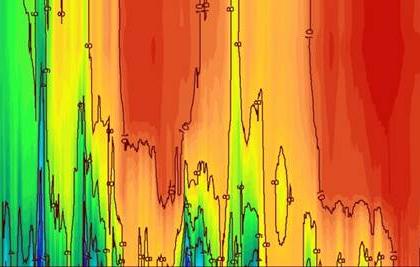
Arctic Wave Glider temperature section obtained on 1-4 August 2011 on the shoreward boundary of the Mackenzie River plume at 1478W.
Wood, K.R., J.E. Overland, S.A. Salo, N.A. Bond, W.J. Williams, and X. Dong (2013): Is there a "new normal" climate in the Beaufort Sea? Polar Res., 32, 19552, doi: 10.3402/polar.v32i0.19552
Since 2007, environmental conditions in the Beaufort Sea have appeared to be consistently different from those in the past. Is a ‘‘new normal’’ climate emerging in the region?
Sea-surface temperatures (SSTs) have been notably warm during the summer, leading to delayed freeze-up in the fall along with large surface air temperature (SAT) anomalies due to the release of stored ocean heat to the atmosphere. In the autumn of 2011 and 2012, SST and SAT anomalies in Arctic marginal seas were the largest observed in the Northern Hemisphere. Since 2007, there has been an increase in easterly... more »